
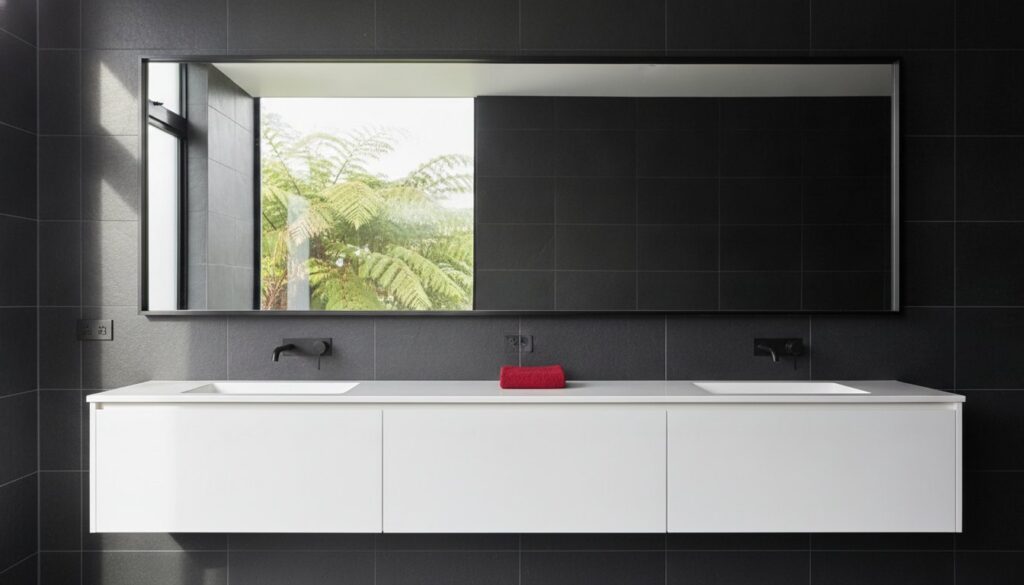
A bathroom mirror is far more than a simple accessory you hang on the wall once the tiles are dry; it’s a permanent structural component that defines the safety and light of your most private space. Many homeowners soon realise that off-the-shelf options rarely account for the specific demands of a high-moisture environment or the unique dimensions of a custom vanity. If you’ve ever worried about a standard mirror desilvering at the edges or shattering in a busy family home, you understand that quality glass bathroom mirrors require a more disciplined approach to fabrication and fit.
We recognise that your home deserves a finish that balances aesthetic excellence with rigorous safety standards. Whether you are dealing with a complex architectural layout or simply want a mirror that won’t succumb to “black edge” damage after a few years, the right expertise makes the difference. This guide explores how to choose, customise, and professionally install bespoke glazing that stands the test of time. We will cover the importance of safety-rated glass, the precision of custom-cut measurements, and the professional installation techniques that guarantee a seamless, moisture-resistant result for your New Zealand home.
Key Takeaways
- Learn how bespoke glazing acts as a light-source multiplier, effectively doubling the perceived floor space in smaller ensuites.
- Understand the science of silvering and why the fabrication quality of glass bathroom mirrors is essential to prevent “black edge” desilvering.
- Evaluate the aesthetic benefits of frameless designs versus the structural texture and colour offered by custom aluminium joinery.
- Discover why professional measurement and fitting are critical to account for out-of-plumb walls and ensure a seamless, long-term finish.
- Gain insight into how end-to-end project management from a family-owned specialist provides a safer, more durable result than DIY alternatives.
The Role of Glass Bathroom Mirrors in Modern Ensuite Design
A bathroom mirror is often the most underrated architectural element in a home renovation. While many view it as a mere surface for morning routines, professional designers treat glass bathroom mirrors as primary light-source multipliers. In the typical New Zealand ensuite where space is often at a premium, a well-placed mirror does more than reflect; it captures available light from windows or skylights and directs it into dark corners. This strategic bounce significantly reduces the need for artificial lighting during the day while making the room feel considerably more open.
Unlike decorative mirrors bought from a homeware store, architectural glazing is designed to withstand the unique rigours of a bathroom. The ensuite is the most demanding room in the house for any glass product. Constant fluctuations in temperature and high humidity levels can quickly degrade inferior materials. By choosing a bespoke solution, you ensure the glass is manufactured to a standard that resists the moisture seepage common in standard retail products. This focus on durability means your investment remains clear and functional for decades rather than just a few seasons.
Maximising Natural Light and Space
Achieving a sense of luxury in a compact bathroom often comes down to the clever use of wall-to-wall glass. When a mirror is custom-fitted to run from the vanity top to the ceiling or across the entire width of a wall, it eliminates the visual “breaks” that make a room feel small. This seamless approach creates a powerful illusion of double the floor space. Standard retail dimensions rarely fit a wall perfectly; they leave awkward gaps that collect dust and disrupt the flow of the design. Bespoke glazing accounts for the reality of New Zealand construction, where walls are rarely perfectly plumb. A professional glazier measures these slight deviations to ensure a millimetre-perfect fit that retail options simply cannot match.
Reflecting Your Personal Style
Your choice of finish should reflect the broader architectural language of your home. Whether you prefer the clean lines of a minimalist frameless look or a more substantial presence, the details matter. Understanding the history of mirror manufacturing reveals how far we’ve come from basic silvering to modern, high-durability coatings. Today, you can choose between various edge treatments, such as a sophisticated polished edge for a modern feel or a bevelled edge for a touch of traditional elegance. For a cohesive aesthetic, many homeowners choose to integrate their mirror design with other elements, such as frameless showers or glass splashbacks. This creates a unified “glass-on-glass” look that feels intentional and professionally curated. By treating the mirror as a structural component rather than an afterthought, you elevate the entire room’s design.
Custom vs. Retail: Why Glass Quality and Fabrication Matter
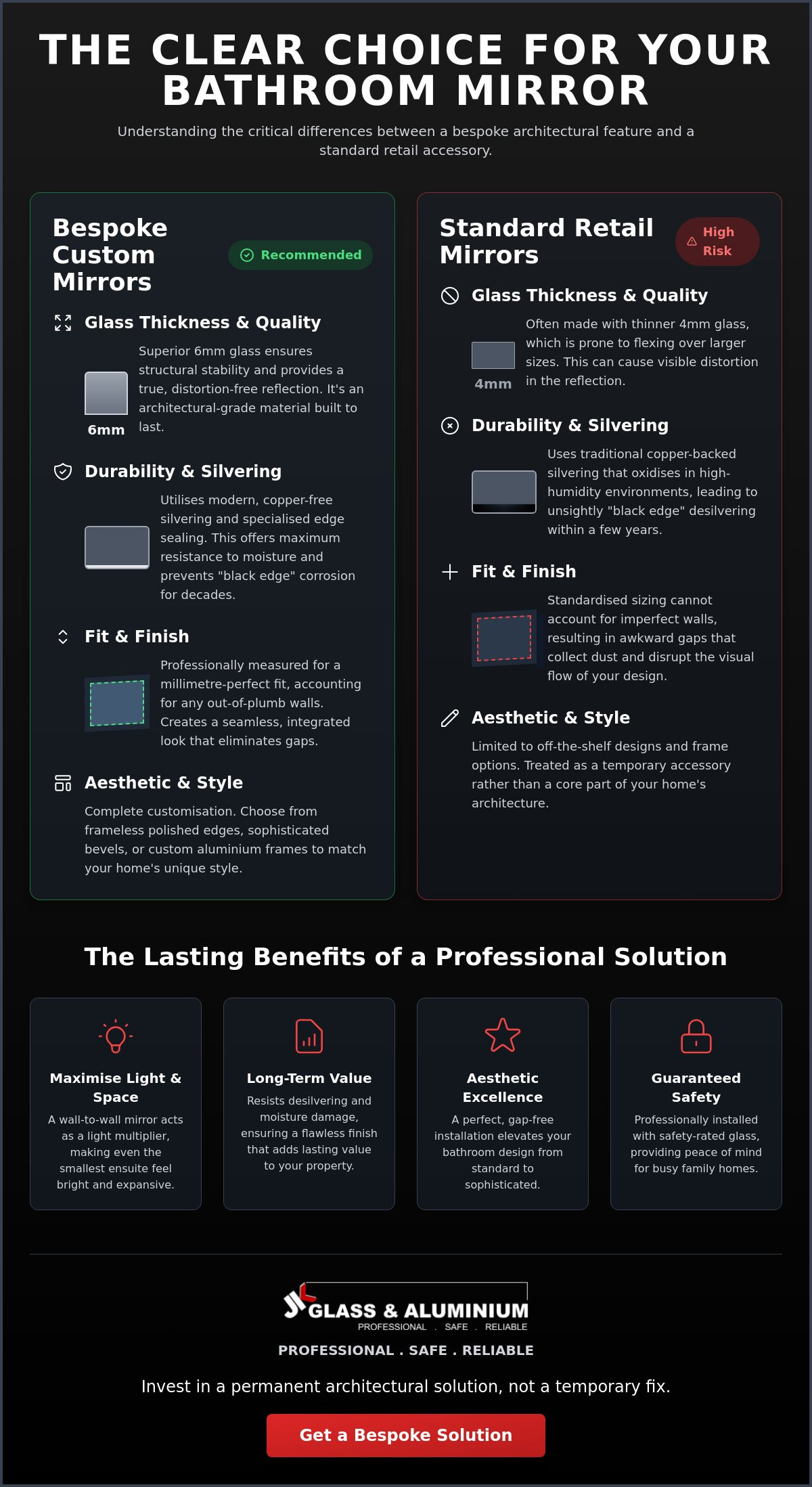
The difference between a mass-produced retail mirror and custom-fitted glass bathroom mirrors often becomes visible only after a few years of use. While a retail mirror might look identical on the showroom floor, it’s typically treated as a temporary accessory rather than a permanent architectural fixture. Most off-the-shelf options use 4mm glass, which is prone to flexing and can distort your reflection over larger spans. In contrast, professional glaziers prefer 6mm glass for its superior structural stability and the “true” reflection it provides. Thickness matters for safety and visual clarity.
The most significant technical difference lies in the silvering process. Traditional mirrors use a copper layer to protect the silvering, but in the high-humidity environments typical of New Zealand bathrooms, this copper can oxidise. This chemical reaction leads to “black edge” or desilvering, where the reflective coating begins to peel and rot away from the glass. High-quality bespoke mirrors utilise copper-free technology. This modern approach offers significantly higher resistance to corrosion and ensures the mirror remains clear for decades. While international federal safety standards for glass often focus on impact resistance, the chemical durability of the silvering is just as vital for long-term value.
Understanding Desilvering and Moisture Damage
Desilvering isn’t just an aesthetic annoyance; it’s a sign that the mirror’s protective layers have failed. Cheap retail products often lack the specialised edge sealing required to prevent steam from penetrating the backing. Professional fabrication involves applying a moisture-resistant seal to every edge, ensuring the reflective layer remains isolated from the damp air. This methodical approach prevents the moisture seepage that destroys standard mirrors. When planning your renovation, choosing bespoke mirrors ensures the fabrication matches the longevity of your tiles and cabinetry.
Precision Fabrication Techniques
Modern glazing relies on advanced CNC cutting to achieve results that hand-cutting cannot match. This proficiency allows for perfect cut-outs for power points, wall-mounted taps, or integrated lighting. Whether you choose a flat polished edge for a contemporary look or a bevelled edge for a more classic finish, the precision of the cut determines the final quality. Custom fabrication also allows for “out-of-square” adjustments. This ensures the glass sits perfectly flush against walls that aren’t perfectly straight, a common reality in many New Zealand homes. This attention to detail creates a seamless finish that off-the-shelf products simply cannot replicate.
Frameless vs. Framed: Choosing the Right Mirror Structure
Deciding between framed and frameless glass bathroom mirrors is more than just a style choice; it’s a decision that affects the maintenance and structural longevity of your ensuite. Frameless designs are often considered the gold standard for modern New Zealand homes, offering a clean, uninterrupted surface that makes smaller rooms feel expansive. However, framed mirrors provide an opportunity to introduce texture and colour, particularly when you want to match the mirror to your existing aluminium joinery. This coordination creates a unified look that ties the mirror into the window frames or shower extrusions already present in the room.
Safety is a non-negotiable aspect of bespoke glazing. In New Zealand, architectural glass must comply with AS/NZS 2208 safety glass standards. For large-scale installations or mirrors located in high-traffic areas, we often recommend Grade A toughened glass to ensure maximum impact resistance. Even when toughened glass isn’t strictly required by code, applying a vinyl safety backing is a critical step we don’t skip. This invisible film ensures that if the glass does break, the shards remain adhered to the backing rather than falling and causing injury. This is a disciplined approach to safety that protects your family for decades.
The Minimalism of Frameless Glass
Frameless mirrors offer a zero-border aesthetic that creates a continuous flow between the glass and your wall finish. Because there is no frame to trap moisture or soap scum, these mirrors are significantly easier to clean and more hygienic over time. Installation typically involves either a high-strength neutral-cure adhesive (glue-fix) or discrete mechanical fixings. Glue-fixing provides the most seamless look, as it allows the mirror to sit almost flush against the tiles, whereas mechanical fixings are often preferred for larger installations where the wall surface might require additional support or where future removal might be necessary.
Structural Integrity and Safety Standards
While local regulations are paramount, many of our quality protocols are informed by global benchmarks, such as the ANSI Z97.1 safety standard, which defines how safety glazing should be marked and tested for impact performance. Using the correct thickness is also vital; a mirror that is too thin for its size will “bow” or flex, leading to a distorted reflection and potential stress on the fixings. We typically utilise 6mm glass for larger spans to maintain a perfectly flat, true reflection that stands the test of time. This focus on structural integrity ensures that your mirror doesn’t just look good on the day of installation but remains a stable, safe feature of your home for the long term.
Professional Installation: Why Measurement and Fitting Are Critical
Professional installation is the final, critical step that transforms a piece of high-quality glass into a permanent architectural feature. While many homeowners are tempted to treat glass bathroom mirrors as a weekend DIY project, the technical complexities of a bathroom environment often lead to costly mistakes. A professional glazier doesn’t just hang a mirror; they perform a comprehensive assessment of the environment. From identifying uneven tile lines to accounting for walls that are slightly out of plumb, this disciplined approach ensures the glass sits perfectly flush without creating internal stress points that lead to cracks.
The risks of DIY installation in wet areas are significant. Inexperienced handling often results in chipped edges or cracked tiles, particularly when drilling into porcelain or natural stone. Beyond the physical risks, using the wrong mounting materials can lead to long-term damage. Many standard construction adhesives contain chemicals that eat through the reflective silvering, causing the “mirror rot” we explored in earlier sections. A trade-qualified professional uses specialised neutral-cure adhesives and sealing techniques that protect the mirror’s backing from both chemical reactions and the constant presence of steam. For homeowners undertaking a broader renovation, understanding the full scope of residential glass installation across your NZ home ensures every glazing element meets the same rigorous standards.
The Precision Measurement Process
The “Glazier’s Measure” involves far more than a standard tape measure. We utilise laser levels to ensure a perfect horizontal alignment with your vanity unit and splashbacks. This precision is essential for accounting for thermal expansion and contraction. In a New Zealand bathroom, temperature fluctuations are frequent and rapid; the glass needs a specific millimetre-tolerance to expand and contract safely within its space. Before the final fixing occurs, a “dry fit” stage allows the glazier to verify that every cut-out for taps or power points aligns perfectly with the underlying plumbing and electrical work.
Safe and Secure Mounting Methods
Choosing the right mounting method depends on the weight of the glass and the structure of the wall. Whether you opt for hidden clips, J-channels, or direct adhesive, the fixings must be rated for the specific load of a 6mm bespoke mirror. Large-scale mirrors are surprisingly heavy, and ensuring the wall can handle the weight is a fundamental safety requirement. Professional installation also includes a critical perimeter seal. This prevents moisture from being trapped behind the glass, which is the primary cause of mould growth and desilvering over time. If you want to ensure your project is completed with this level of technical proficiency, you can request a professional installation quote here to guarantee a seamless and safe result.
Bespoke Mirror Solutions by JK Glass & Aluminium
JK Glass & Aluminium is a family-owned business built on a foundation of technical proficiency and local reliability. With decades of experience in the New Zealand glazing industry, we have developed a reputation for delivering results that move beyond standard expectations. We understand that glass bathroom mirrors are not just functional surfaces; they are essential architectural elements that require a disciplined approach to fabrication and fitting. As your authoritative partner, we manage the technical complexities of your project from the initial design phase through to the final installation, ensuring you receive a finish that is both visionary and practical.
Our commitment to quality is rooted in the belief that a project is only as good as the materials used. We source glass specifically engineered to withstand the unique environmental demands of New Zealand homes. By prioritising long-term durability over “quick fix” retail solutions, we provide our clients with the peace of mind that comes from knowing their installation will remain clear and secure for decades. This legacy-driven focus means we never accept “average” results, whether we are working on a single residential ensuite or a large-scale commercial fit-out.
The JK Glass & Aluminium Difference
Precision is the cornerstone of our operation. Whether you are looking for a minimalist frameless design or a mirror integrated with custom aluminium joinery, our team applies rigorous professional standards to every cut. We specialise in custom fabrication for unique spaces where standard sizes simply won’t suffice. Our expertise allows us to navigate the challenges of out-of-plumb walls and complex cut-outs for integrated fixtures with ease. By maintaining a steady, methodical rhythm throughout the project, we ensure that every mirror is fitted with the millimetre-perfect accuracy required for a truly seamless look.
Safety remains our primary concern. We strictly adhere to all relevant New Zealand glazing standards, ensuring that every installation is as secure as it is beautiful. This safety-conscious mindset extends to our wider range of services. We offer a comprehensive suite of glazing solutions, allowing for the perfect integration of your mirrors with frameless showers, splashbacks, or even glass balustrades. This holistic approach ensures a unified aesthetic throughout your home, managed by a single team of dedicated specialists who understand the nuances of architectural glass.
Start Your Bathroom Transformation
Beginning your renovation with us is a straightforward and transparent process. Our team organises a comprehensive on-site measurement and consultation to understand the specific requirements of your space. We provide clear, professional guidance on the best glass thickness, edge finishes, and mounting methods for your particular environment. This ensures that the final result is not only aesthetically excellent but also structurally sound and moisture-resistant. If you are ready to move beyond the limitations of standard retail products and pursue a more ambitious glazing goal, we invite you to enquire about our custom mirror fitting services today. Let us help you create a bathroom that reflects the high standards of your home.
Elevating Your Ensuite with Precision Glazing
A bespoke mirror is the final touch that transforms a functional bathroom into a curated sanctuary. By prioritising high-quality glass bathroom mirrors over mass-produced alternatives, you protect your home from the long-term risks of desilvering and structural instability. We’ve explored how professional measurement and the use of copper-free glass ensure your investment survives the demanding moisture of an ensuite environment. Whether you are aiming for a minimalist frameless look or a bold architectural statement, the difference lies in the precision of the fabrication and the discipline of the installation.
JK Glass & Aluminium is a family-owned and operated New Zealand business dedicated to these high standards. We are specialists in custom glass fabrication and precision fitting, ensuring every installation is fully compliant with NZ safety glazing standards. Our team manages the complexities of your project so you can focus on the final aesthetic. We invite you to contact JK Glass & Aluminium for a professional mirror measure and quote to begin your transformation. Your vision for a safer, more stylish home is well within reach.
Frequently Asked Questions
What is the best thickness for a glass bathroom mirror?
The industry standard for high-quality bespoke mirrors is 6mm glass. While retail stores often sell 4mm options to reduce costs, thinner glass is prone to flexing, which creates a distorted reflection. Choosing a 6mm thickness ensures the mirror remains perfectly flat and provides the structural stability required for larger wall-to-wall installations in New Zealand homes.
Can I get a mirror cut to fit a specific shape or around a cabinet?
Yes, custom fabrication allows for precise cut-outs to accommodate power points, cabinetry, and wall-mounted taps. Using advanced CNC technology, we can shape glass bathroom mirrors to fit perfectly into architectural niches or around bulkhead lighting. This creates a seamless, integrated look that standard off-the-shelf mirrors simply cannot provide.
How do I prevent my bathroom mirror from rusting or getting black edges?
You can prevent black edges by choosing copper-free glass and ensuring every edge is professionally sealed. Black edges, or desilvering, are caused by moisture reacting with the mirror’s reflective layer. Using neutral-cure adhesives during installation is also critical, as standard glues contain chemicals that can eat through the backing over time.
Is it safer to have a framed or a frameless mirror in a family bathroom?
Both options are equally safe provided they are installed to professional standards with a vinyl safety backing. Frameless mirrors are often preferred in family environments because they have no gaps to trap moisture or mould. If an impact occurs, the safety backing ensures the glass shards remain adhered to the film rather than falling.
Do bathroom mirrors need to be made of safety glass?
Yes, any mirror installed in a “critical location” must comply with AS/NZS 2208 safety standards. In a bathroom, this typically involves using Grade A toughened glass or glass with a safety-rated vinyl film. These measures are designed to minimise the risk of injury by ensuring the glass breaks safely if an accident happens.
How long does it take to have a custom mirror fabricated and installed?
The typical timeframe for a custom mirror project is between 7 and 14 working days from the final measure. This period allows for precision cutting, edge polishing, and the application of safety coatings. Once the fabrication is complete, the actual on-site installation usually takes our team only a few hours to finish.
Can a custom mirror be installed over existing tiles?
Yes, custom mirrors are frequently installed directly over existing tiles using specialised, non-corrosive adhesives. This is an excellent solution for renovations where you want to avoid the cost and mess of removing old wall finishes. Our glaziers ensure the tile surface is flat and stable before securing the glass for a flush, professional result.
What is the difference between a standard mirror and a low-iron mirror?
Standard glass has a natural green tint caused by iron content, which is most visible on the edges. Low-iron glass is manufactured to be crystal clear, providing a much truer colour reflection and a brighter aesthetic. If your bathroom features white tiles or light colours, a low-iron mirror will provide the most accurate and vibrant reflection possible.